Kitchen Storage Shelves for the Tight Apartment
May 13, 2013
One of the difficult things about living in a small apartment is that often there is a lack of storage space. It seems like every room is just a few cubic feet short of the storage that is necessary for everyday life. No room is immune from this apartment storage space scourge. One room that is particularly bad is the kitchen. Luckily there are kitchen storage shelves that allow you to increase storage space.
In my apartment’s kitchen, all we have in the way of kitchen storage shelves is a single pantry and two cabinets. For two people, that is a severely limited space to store your fruits, vegetables, canned goods and other provisions.
Not to mention that typically the biggest and bulkiest items to store in the kitchen, your serve ware, cookware and flatware! It can be quite a dilemma figuring out where to store all of that stuff in your small apartment kitchen.
One item I would recommend to increase your kitchen storage is a Three Tier Shelf. This rack is perfect for kitchen storage because the shelves have plenty of space for storage. Another great benefit of these metal storage shelves are open, so crumbs and other items fall to the floor instead of messing up the shelves.
I use a few of these wire shelves in the kitchen to increase my storage space. It helps to place them in discreet spaces around the kitchen, like in the corner. That way I add some storage space to the room without taking up too much usable floor space.

Kitchen Storage Shelves come in a variety of shapes and sizes!
Another great place to use wire shelves is under the sink. The shelves I linked to above are too tall to work for under-sink organization, but there are shorter models available, such as the Stacking Shelf seen above. A one-tier or two-tier kitchen shelf maximizes the space of your under sink area, which is perfect for storing cleaning supplies and other kitchen items you want to keep separate from foodstuffs.
Closet Shoe Storage Tips – Bigger Is Not Better
May 6, 2013
I have to admit, my wife and I can be quite messy when it comes to proper closet shoe storage and organization. When one of us needs to find a seldom worn pair of shoes, it ends up being a “search and rescue” operation for that shoe. Diving into the dark depths of our entryway closet, it’s not unheard of for one of us to waste an entire morning or afternoon searching for the missing pair of footwear.
When we first moved into our apartment, we thought the best way to organize and store our shoes was to use a large plastic tub. At first, that seemed like a great closet shoe storage solution. The tub was durable and rugged and we did not have to worry about it breaking or cracking. Also, the tub provided incredible storage capacity, able to hold both of our shoes with ease.
However, this plastic tub ended up not being the viable closet shoe storage we thought it would be. After a few weeks of using this method to store our shoes, we ran into some issues.
My wife was running late for a very important meeting, and needed to find one particular pair of shoes. She needed to find this one pair of shoes, and these shoes only. The client she was meeting with loves glittery purple shoes. My wife needed the meeting to go well, so she needed to wear those glitter shoes.
You can imagine how cluttered your closet shoe storage is when your wife can’t even find her purple glitter shoes! Those things shine like a diamond in the sun! When we finally did find the shoes at the bottom of the tub, she was running super late! She barely made it to her meeting on time.

But we found the closet shoe storage of our dreams…
After that close call we knew something needed to be done to improve our closet shoe storage. We purchased a handful of 2-Tier Stackable Shoe Racks, using them modularly to store and display our shoes. What sets these racks apart from typical shoe storage is that they provide display as well as storage. That way when you need to find a specific shoe, you don’t have to go digging around in a bucket for said shoe.
How to Organize Your Home Office – Archive Files
April 29, 2013
My last entry showed you how to better organize your appointments by giving you tips on how to make the best use of your calendar. The next area of your home office that I will help you with is your files. Given that you recently filed your taxes, I am going to focus on archiving files.
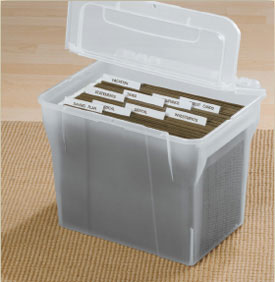
There are three main categories of files: reference, action, and archived. Archived files are reference files that you no longer need to access on a regular basis, but you need to keep for tax, legal or historical purposes. These files should be stored separately from your reference files to avoid using your “prime real estate” on documents that are seldom accessed. If you have enough file storage space in your office, you can dedicate a drawer or set of drawers to your archived files. Often times, the best location to store them is your basement. My favorite storage solution is the clear stackable plastic file box. These are inexpensive, portable, and stackable. Put your hanging files in and label the outside with ‘Archived Files’ and the subject. They can be stored in a closet, on a shelf, or even stacked on the ground. Most homes would only need one or two of these.
Past tax papers are the most common type of file archived in homes. In this example, the IRS recommends that you keep seven years of supporting documentation. Each year after you file your taxes, add the new file to your archived file box and remove the oldest file. In the event of an audit, you will be so happy that you know right where to find all the information you need. Archiving files will also maximize your file space in your home office.
Donna Lindley, Certified Professional Organizer and owner of Rochester Hills, MI-based Organize Your World, Inc